
U.S. Immigration Attorney






The E-2 Visa for Canadians: Build Your Business in the United States
If you’re a Canadian business owner thinking about the U.S. market, you’re in good company. Canadians are among the largest groups of E-2 treaty investors in the world, and the process for Canadians is more direct than for almost anyone else. Here is what Canadian entrepreneurs should know before making the move.
Why more Canadians are looking south
Canada remains a strong place to live, and its economy is still growing. The IMF expects Canada to post the second-fastest growth in the G7 in 2026, behind only the United States. But for business owners, the gap between the two economies has become hard to ignore.
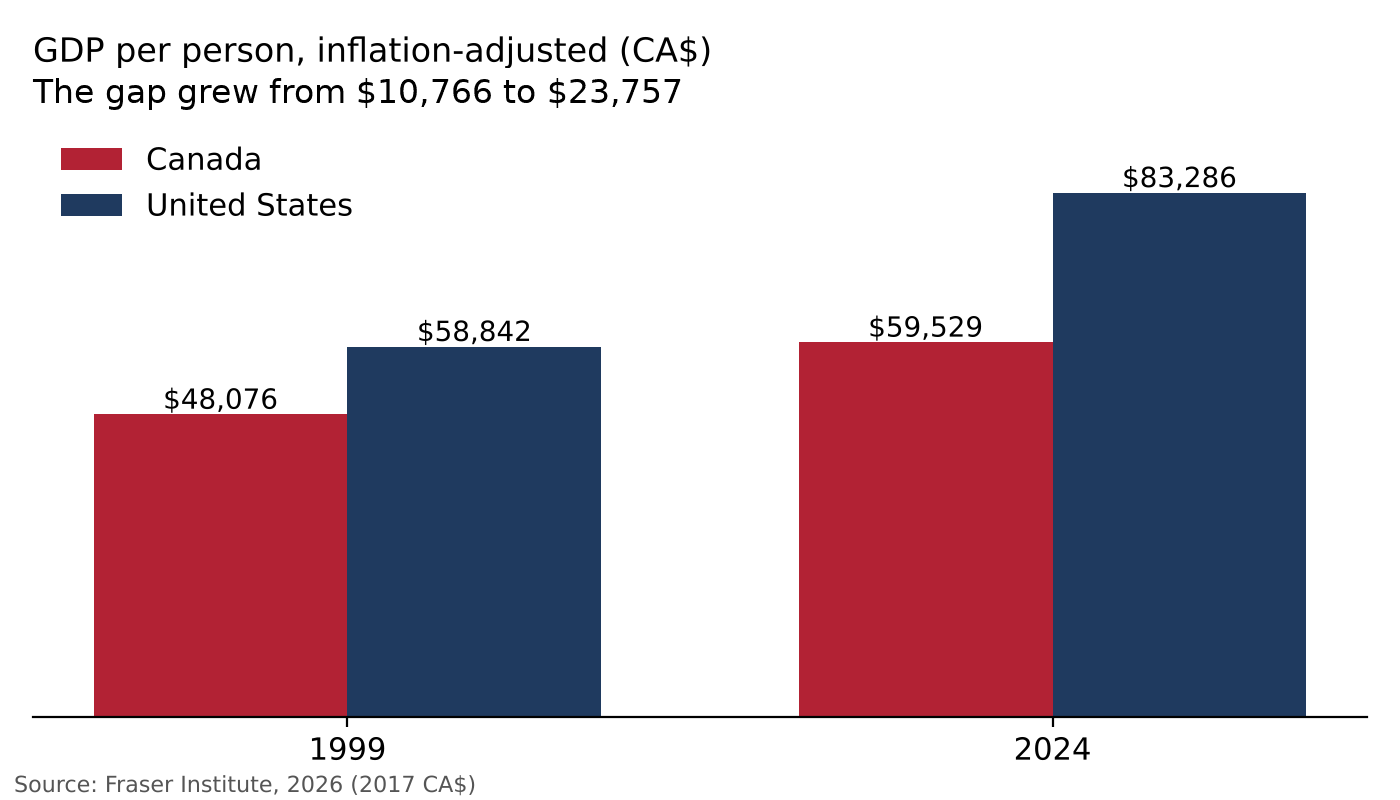
In 1999, inflation-adjusted GDP per person in the U.S. was about CA$10,800 higher than in Canada. By 2024, the gap had more than doubled, to about CA$23,800.
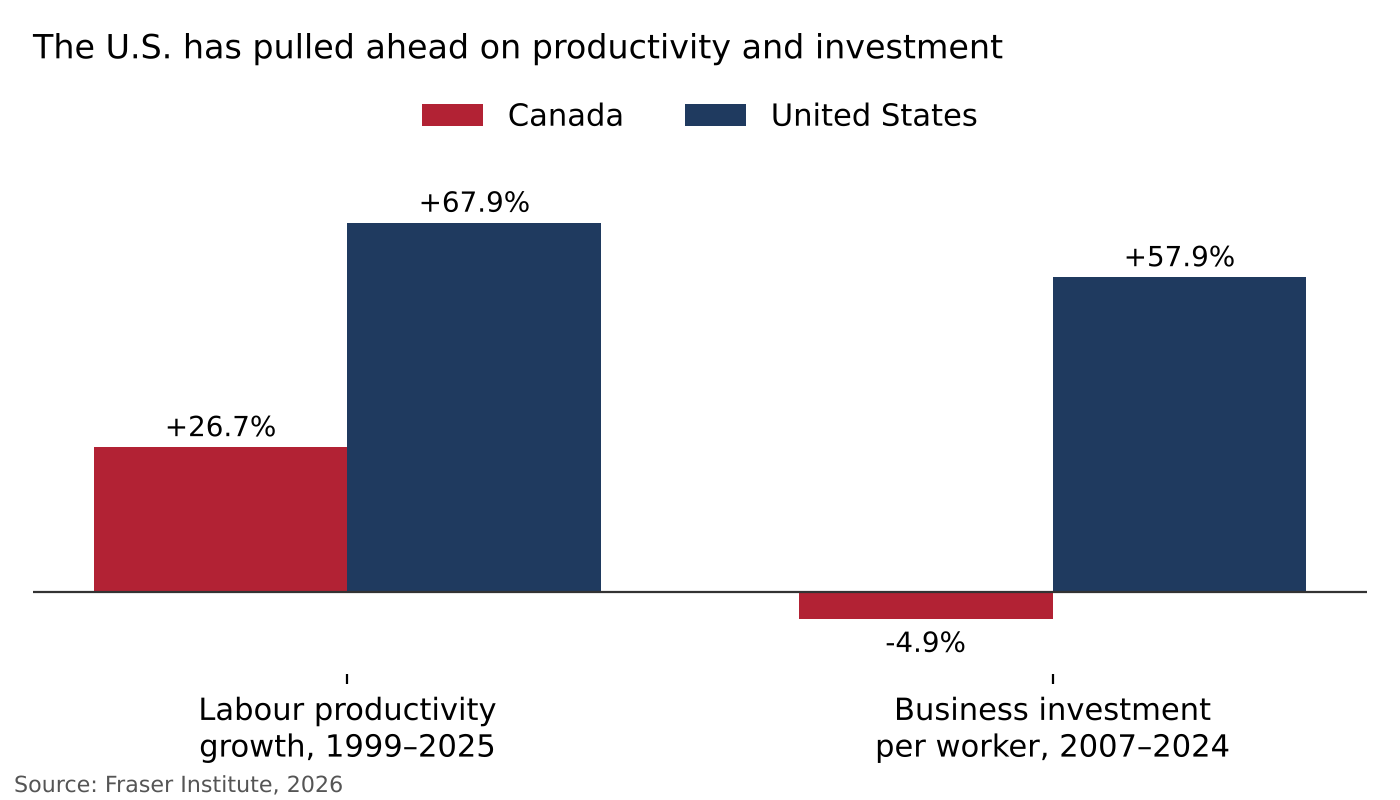
Behind that gap is a divide in productivity and investment. From 1999 to 2025, labour productivity grew 26.7% in Canada and 67.9% in the U.S. From 2007 to 2024, business investment per worker fell 4.9% in Canada and rose 57.9% in the U.S.
For an entrepreneur, those numbers point to the same thing: a market roughly ten times larger, with more capital chasing growth, just across the border. And a U.S. company sells to U.S. customers without shipping its goods across that border.
Canadians are already doing it
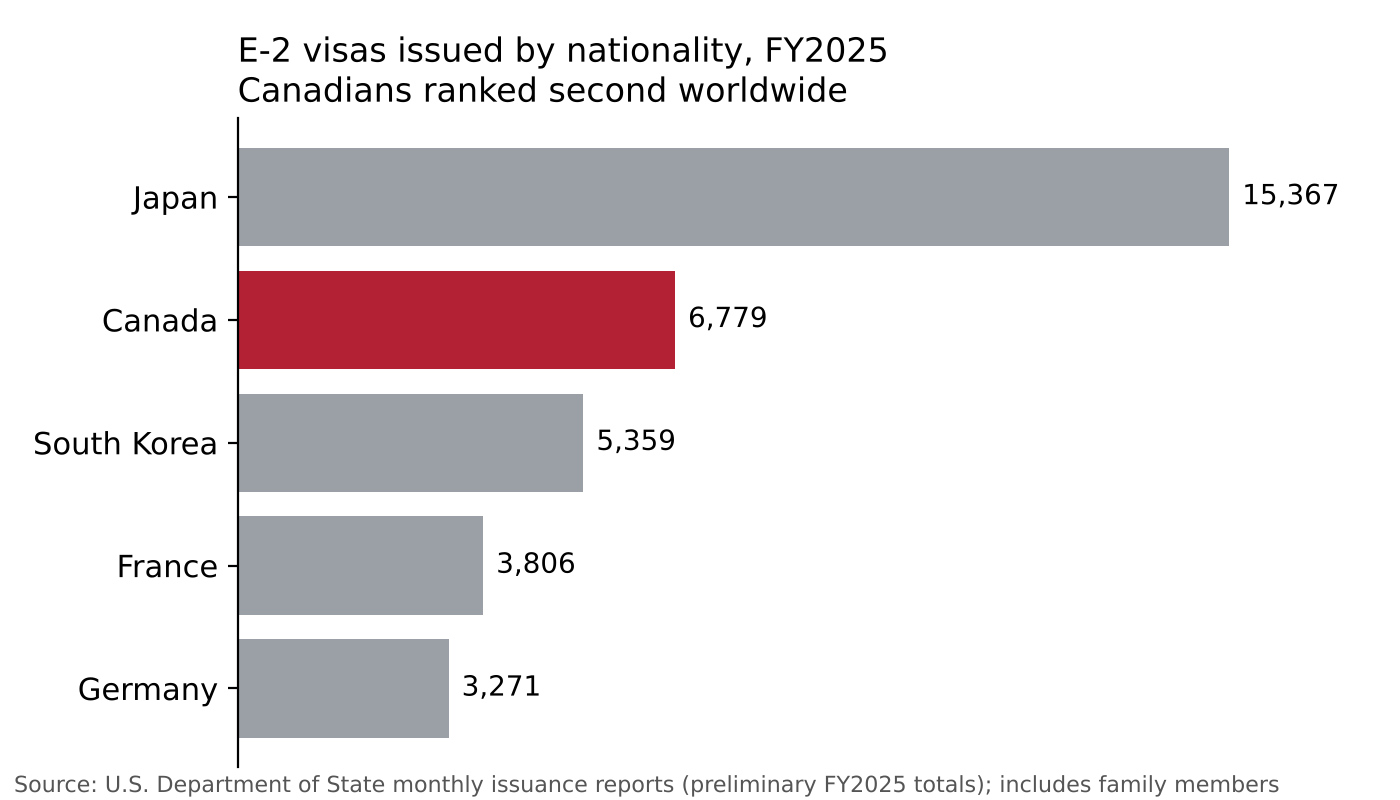
In fiscal year 2025, Canadians received 6,779 E-2 visas, more than any other nationality except Japan, and about the same as the year before. Those numbers include spouses and children, but each family represents a Canadian building or buying a business in the United States, from franchises and service companies to tech start-ups and real estate operations.
Why the E-2 works so well for Canadians
Canada is a treaty country. Canadian citizens qualify for both the E-2 treaty investor visa and the E-1 treaty trader visa. Eligibility depends on citizenship, not residence: a permanent resident of Canada who isn’t a Canadian citizen doesn’t qualify through Canada.
There’s no minimum investment. The investment must be substantial relative to the cost of the business, not a fixed dollar figure. A lower-cost service business and a larger franchise can both qualify when the numbers are proportionate.
One consulate, close to home. Every first-time Canadian E-2 application goes through the U.S. Consulate General in Toronto. For most clients that means a short trip, in English, at a post that handles a high volume of Canadian cases.
Five years at a time, renewable indefinitely. Canadians receive E-2 visas valid for five years, and there is no lifetime cap. As long as the business keeps qualifying, you can keep renewing.
Your employees can follow. Once your company is registered, Canadian managers and essential employees can join you on E-2 status, and later applicants can interview in Calgary, Montreal, Ottawa, Vancouver or Toronto.
One point surprises many Canadians: visa-free entry is not permission to work. Canadians can visit the United States without a visa, but that status doesn’t allow you to work and tops out at six months. The E-2 is a legal route to living in the U.S. and running your own business there. For Canadians it is issued for five years and can be renewed indefinitely.
What makes the Toronto consulate different
Toronto runs one of the most structured E-2 processes anywhere, and packages that don’t follow it are sent back.
- Everything in one PDF of no more than 50 pages and 20 MB. No zip files and no shared folders. Forms, civil documents, the passport bio page and tab dividers don’t count toward the 50 pages, but your business plan, bank records and lease do.
- File first, book later. You email the package to the consulate and wait. Toronto tells you when its review is done and how to schedule the interview.
- A cover letter without padding. The consulate asks for a letter stating exactly how you qualify, and specifically asks applicants not to include long quotations from the regulations.
- A fixed order. Evidence follows a set sequence of numbered sections, with lettered sub-tabs when a section holds more than two documents.
- A paper copy at the interview. You bring a physical copy of the entire package, even though you already filed it electronically.
- Your passport comes home by courier. If approved, your passport and visa are returned by Canada Post, normally within 7 to 10 business days.
- Company registration lasts five years. After that, the next applicant from your company must re-register it.
For Canadians already living in the U.S., one more rule matters. Since September 6, 2025, the State Department has required visa applicants to apply in their country of residence or nationality, so for most Canadians that means Toronto.
Mistakes we see Canadians make
- Assuming visa-free entry lets them work in the U.S. It doesn’t, and it caps their stay at six months
- Treating the TN as a route to owning a business, when it is for employment
- Moving money between accounts without keeping the paper trail that proves where it came from
- Filing a 150-page package at a post that accepts 50
- Choosing a business that will only ever support the owner, which is the classic marginality refusal
Why Canadians choose Grant Dwyer Law | Visas USA
Most of our clients are Canadian, and the E-2 is the core of our practice. Over more than 12 years in immigration law, we have prepared a large number of Toronto filings and learned what the E-Visa Unit expects: tight packages, clear cover letters and evidence that answers the officer’s questions before the interview. We also handle E-1 treaty trader, L-1 intracompany transfer and EB-5 cases, so we can plan the next step, including a green card, from the start.
Thinking about the move? Book a consultation and we’ll tell you, plainly, whether your business qualifies and how to build the strongest Toronto filing.
grant@visas-usa.org · 305-215-7586
Related: Toronto consulate guide · E-2 Treaty Investor Visa · E-2 visas for employees · E-1 Treaty Trader Visa
Sources: Fraser Institute, Squandering the Canadian Century, Part 1 (2026); International Monetary Fund, World Economic Outlook (April 2026), as reported by the Government of Canada; U.S. Department of State, monthly nonimmigrant visa issuance reports, FY2025; U.S. Embassy & Consulates in Canada, Treaty Trader and Investor Visas and Supporting Documentation for New Cases (ca.usembassy.gov).
Contact Us